
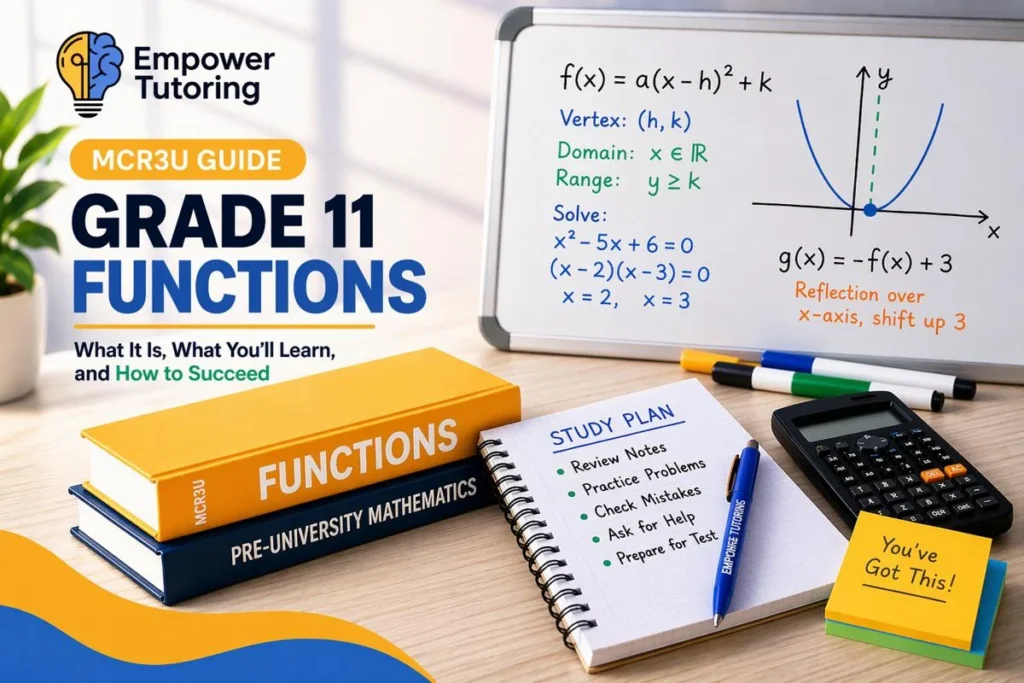
Grade 11 Functions (MCR3U) is a major turning point in a student’s math journey, where math shifts from basic problem-solving to deeper analysis, abstract thinking, and real-world application.
Many students find this course challenging at first, not because the material is impossible, but because it requires a new way of thinking. Instead of just solving equations, you’re expected to understand relationships, interpret graphs, and explain how and why functions behave the way they do. That’s why many families turn to Empower Tutoring, where students receive personalized, one-on-one guidance tailored to their learning style and current coursework.
With the right support system in place, Grade 11 Functions becomes much more manageable and even enjoyable. This guide will walk you through what the course is, what you’ll learn, and how to succeed.
What Is Grade 11 Functions (MCR3U)?
Grade 11 Functions (MCR3U) is a university-preparation math course in the Ontario curriculum that focuses on the study of functions (mathematical relationships between variables).
In simple terms, a function shows how one value (the input) affects another value (the output). For example, if you plug a number into a function, it produces a specific result based on a defined rule.
What makes this course different from earlier math classes is its emphasis on understanding these relationships across multiple representations:
- Algebraic (equations)
- Graphical (graphs)
- Numerical (tables of values)
Students are expected to move between these forms fluidly and interpret what they mean in context.
MCR3U also prepares students for Grade 12 Advanced Functions and Calculus, making it a key prerequisite for many university programs, especially in business, science, and engineering.
Grade 11 Functions Curriculum
Understanding the Grade 11 Functions curriculum, a.k.a. the structure of the course, can make a major difference in how a student approaches it. At Empower Tutoring, we offer Grade 11 math tutoring to reinforce these concepts and build confidence.
While the exact order of the Grade 11 Functions curriculum may vary slightly by school, the core concepts remain consistent across Ontario:
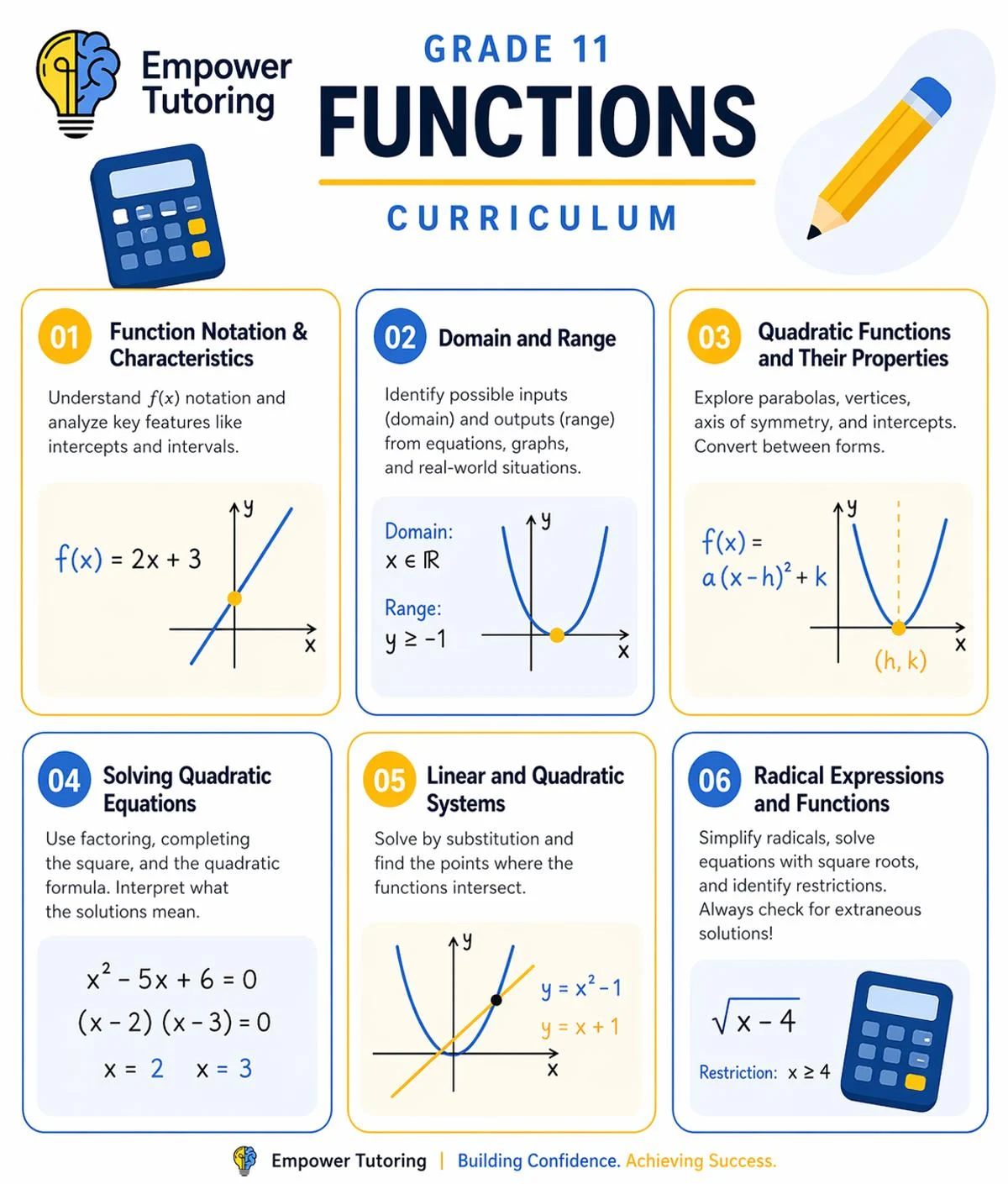
Function Notation and Characteristics of Functions
The course begins by introducing function notation, which becomes the foundation for everything that follows. Instead of writing equations as y = 2x + 3, students use notation like f(x) = 2x + 3 to represent relationships.
This unit also focuses on analyzing the characteristics of functions. Students learn how to identify key features such as intercepts, intervals of increase and decrease, and how graphs behave over time.
This is often where students first experience the shift toward more conceptual thinking, as they are asked not just to calculate, but to interpret.
Domain and Range
Domain and range are essential concepts that define the limits of a function. The domain represents all possible input values, while the range represents all possible outputs. At first glance, these ideas seem simple, but they become more complex as functions introduce restrictions.
Students learn how to determine domain and range from equations, graphs, and real-world contexts. This skill becomes especially important in later units, where restrictions play a major role in determining valid solutions.
Quadratic Functions and Their Properties
Quadratic functions are one of the most heavily emphasized topics in Grade 11 Functions. These functions produce parabolic graphs and are used to model a wide range of real-world situations. Students explore how to identify key features such as the vertex, axis of symmetry, and intercepts, and how these features describe the behaviour of the function.
A major focus of this unit is understanding how different forms of a quadratic equation reveal different information. Students are expected to convert between standard form, vertex form, and factored form, and to use each strategically depending on the problem.
This unit requires both algebraic skill and visual understanding, making it one of the most important and often most tested areas of the course.
Solving Quadratic Equations
Closely connected to quadratic functions is the ability to solve quadratic equations. Students learn multiple methods, including factoring, completing the square, and using the quadratic formula. Each method has its advantages, and choosing the right one becomes part of the problem-solving process.
Beyond simply finding solutions, students are also expected to interpret what those solutions represent. In many cases, answers have real meaning, such as points of intersection or critical values in a scenario. Accuracy is critical here, as small algebraic errors can lead to incorrect solutions.
Linear and Quadratic Systems
This unit combines linear and quadratic equations to explore how different functions interact. Students learn how to solve systems by substitution and interpret the solutions both algebraically and graphically. These solutions represent the points where the two functions intersect.
What makes this unit challenging is that it requires students to bring together multiple skills at once. Algebra, graphing, and interpretation all play a role, making it a strong test of overall understanding.
Radical Expressions and Functions
Radical expressions introduce square roots and other roots into the course, adding another layer of complexity.
Students learn how to simplify radical expressions, solve equations involving radicals, and identify restrictions that affect the domain. These restrictions are especially important, as they determine whether a solution is valid.
One of the key challenges in this unit is dealing with extraneous solutions: answers that appear correct algebraically but do not satisfy the original equation. This reinforces the importance of checking solutions carefully, and students getting the support they need to succeed.
Biggest Mistakes Students Make In Grade 11 Functions (MCR3U)
Many students struggle in MCR3U not because the material is too difficult, but because of avoidable habits.
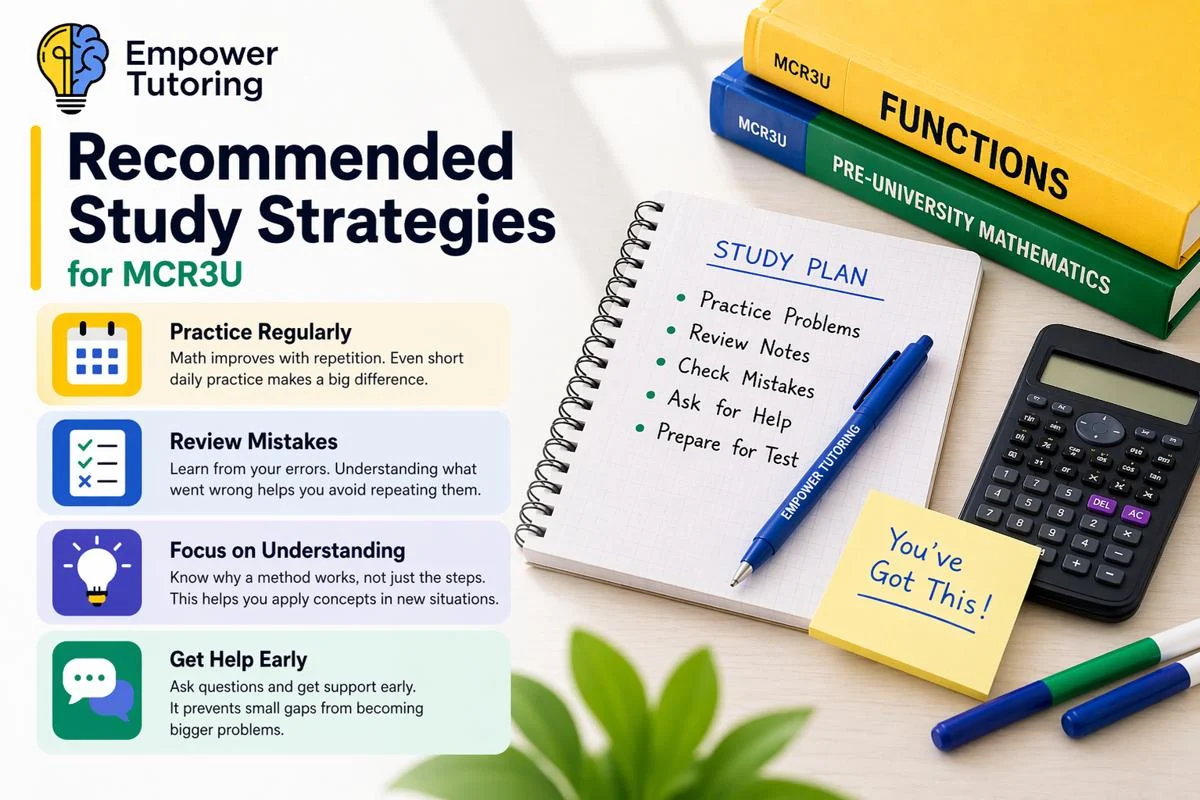
- Memorizing Instead of Understanding: Relying on memorization makes it hard to apply concepts in new ways. It’s important for students to focus on understanding how functions work, not just the steps.
- Falling Behind Early: Early topics like function notation and domain are foundational. Gaps here make later units much harder, which is why it’s crucial to get support when needed.
- Skipping Steps: Rushing through problems often leads to careless mistakes. Writing out full steps improves accuracy and clarity.
- Not Reviewing Mistakes: Tests are learning opportunities, and reviewing errors helps prevent repeating them.
- Waiting Too Long to Get Help: Small misunderstandings can quickly grow, so getting help early can help keep you on track.
How Grade 11 Functions Is Used in Real Life
While Grade 11 Functions can feel abstract, many of the concepts have direct real-world applications. Understanding how functions work helps students analyze relationships, interpret data, and make informed decisions in a variety of fields.
Because these skills extend across subjects, many students also benefit from science tutoring to strengthen their understanding of how math concepts apply in areas like physics, chemistry, and data analysis.
Physics and Motion
One of the most common real-world applications of functions is in physics. Quadratic functions are used to model motion, such as the path of a projectile or how an object moves over time. Graphing these functions helps explain speed, distance, and acceleration.
Because these concepts carry directly into physics courses, many students benefit from reinforcing them across both subjects. At Empower Tutoring, we offer both math and physics tutoring, helping students better understand how these relationships apply in real-world scenarios and build confidence in more complex concepts.
Business and Finance
Functions play a key role in business and finance. Companies use them to model profit, revenue, and growth over time. Understanding these relationships allows businesses to make predictions, set goals, and optimize performance.
Data Analysis and Trends
Functions are essential for interpreting graphs and identifying patterns in data. Whether analyzing economic trends, population growth, or scientific data, understanding functions allows you to make sense of real-world information and predict future outcomes.
Everyday Applications of Functions
Beyond specific fields, functions are used in everyday problem-solving. From comparing costs to understanding how changing one variable affects another, the ability to analyze relationships is a valuable life skill developed in MCR3U.
Frequently Asked Questions About Grade 11 Functions (MCR3U)
What is Grade 11 Functions (MCR3U)?
Grade 11 Functions is an Ontario university-preparation math course that focuses on understanding relationships between variables through functions. It builds the foundation for advanced math courses like Advanced Functions and Calculus.
What topics are covered in Grade 11 Functions?
The course covers function notation, domain and range, quadratic functions, solving quadratic equations, systems of equations, and radical expressions. Students also learn how to interpret and analyze graphs.
Is Grade 11 Functions hard?
Many students find Grade 11 Functions more challenging than previous math courses because it requires deeper understanding and multi-step problem solving. However, with consistent practice and strong study habits, it is very manageable.
Why is MCR3U important?
MCR3U is a prerequisite for Grade 12 Advanced Functions, which is required for many university programs. It plays a key role in preparing students for higher-level math and analytical thinking.
How can I succeed in Grade 11 Functions?
Success comes from practicing regularly, understanding key concepts, reviewing mistakes, and asking for help when needed. Staying consistent throughout the course is the most important factor.
What is the difference between Grade 10 math and Grade 11 Functions?
Grade 10 math focuses more on basic algebra and procedural problem-solving, while Grade 11 Functions introduces more abstract thinking, graph analysis, and deeper conceptual understanding.
Is Grade 11 Functions related to physics?
Yes, many concepts in Grade 11 Functions, especially graphing and quadratic relationships, are used in physics. Understanding how variables relate is essential in topics like motion and forces.
Do I need MCR3U for university?
Yes, most university programs that require math expect students to complete Grade 12 Advanced Functions, which requires MCR3U as a prerequisite.
Can tutoring help with Grade 11 Functions?
Tutoring can help students better understand difficult concepts, improve problem-solving skills, and stay on track with coursework. It’s especially helpful for students who are struggling or aiming for higher grades.
How do I start improving my grade in MCR3U?
Start by reviewing foundational concepts, practicing regularly, and identifying weak areas. Get help early and stay consistent! We’re here to support you.
How can I start Grade 11 Functions tutoring sessions?
At Empower Tutoring, we make getting started with Grade 11 Functions (MCR3U) simple. Most students begin with a free trial session, where a tutor assesses their current understanding, identifies learning gaps, and discusses academic goals.
From there, students are matched with a tutor who fits their learning style and schedule. Our ongoing sessions focus on current coursework, strengthening key concepts, and preparing for tests and exams. Get in touch with us today to get started!