

STEM, also known as science, technology, engineering, and math, is more than just a group of subjects. It’s a way of thinking. STEM skills, like problem-solving, critical thinking, and the ability to analyze and apply information, are becoming essential for students preparing for the future.
Today, these skills go far beyond traditional STEM careers. Whether a student is interested in business, healthcare, or design, the ability to think logically, solve problems, and adapt to new challenges plays a major role in long-term success.
That said, building STEM skills isn’t always easy. These subjects often build on one another, and in a typical classroom setting, it’s easy to fall behind or miss how concepts connect across different courses. That’s where the right support can make a real difference.
At Empower Tutoring, we help students strengthen STEM skills through personalized, one-on-one support across subjects like math, science, and computer science. Our private online tutors focus not just on improving grades, but on helping students understand connections, think critically, and approach problems with confidence.
This guide breaks down what STEM is, what STEM skills look like in practice, and how students can start building them today.
What is STEM?
STEM stands for Science, Technology, Engineering, and Mathematics. It’s both a group of subjects and an approach to learning that focuses on problem-solving, critical thinking, and real-world application.
In simple terms, STEM is about:
- Science → understanding how the world works (biology, chemistry, physics)
- Technology → using tools, software, and systems (computers, coding, digital tools)
- Engineering → designing and building solutions to problems
- Mathematics → working with numbers, patterns, and logical reasoning
What makes STEM important is how these subjects work together. Rather than learning each one in isolation, students are encouraged to apply them in combination; like using math and science to solve real-world problems or technology to test ideas.
In school, STEM shows up in courses like math, science, and computer science, but the skills students develop, like problem-solving, data analysis, and critical thinking, are useful in almost every subject and future career.
What Are STEM Skills?
STEM skills refer to a combination of knowledge and abilities connected to science, technology, engineering, and mathematics. More importantly, they represent a way of thinking: focus on problem-solving, critical analysis, and applying knowledge to real-world situations.
These skills go beyond memorizing formulas or facts. They involve understanding how concepts connect, asking meaningful questions, and using logic and creativity to find solutions.
When people ask what are stem skills, they’re usually referring to both technical and transferable abilities.
On the technical side, STEM skills include:
- Mathematical reasoning and data analysis
- Scientific investigation and experimentation
- Coding, programming, and technology use
- Engineering design and problem-solving
On the transferable side, they include:
- Critical thinking
- Logical reasoning
- Creativity and innovation
- Collaboration and communication
- Persistence through challenging problems
This combination is what makes STEM skills so valuable! They apply across almost every subject and career path.
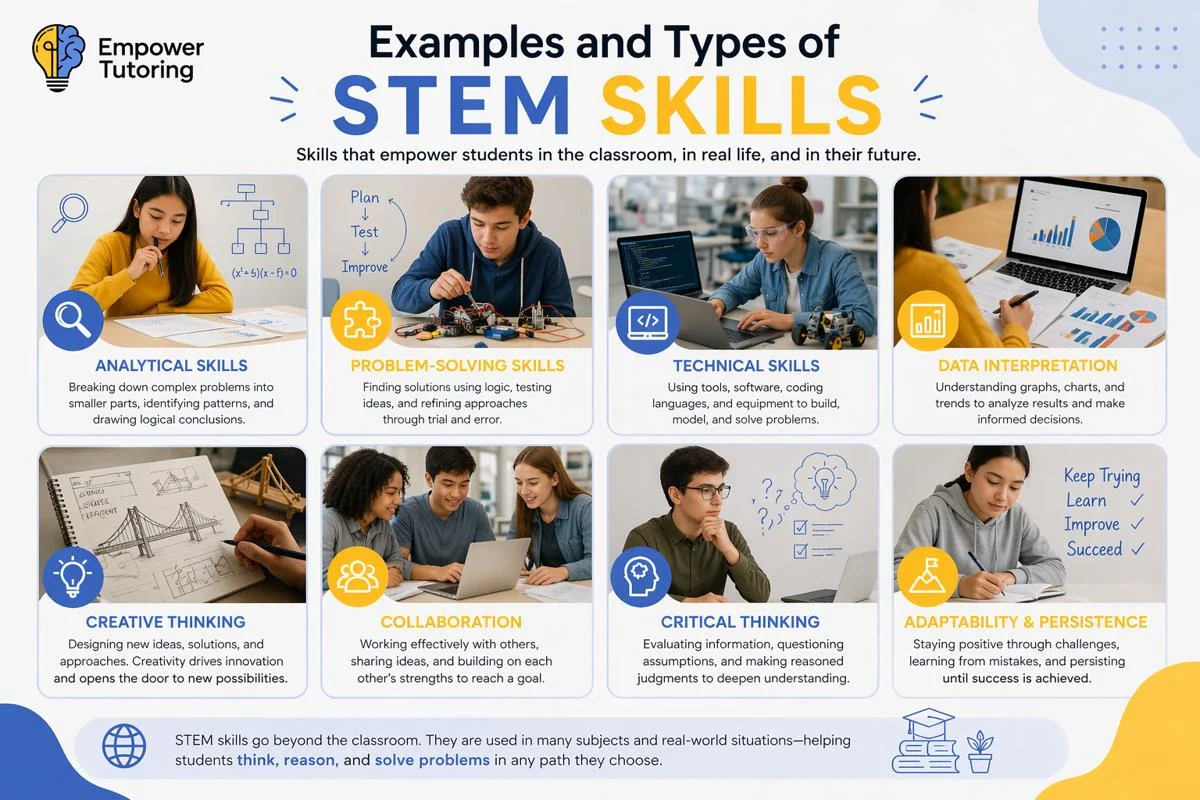
Examples and Types of STEM Skills
STEM skills can show up in many different ways depending on the subject, grade level, or real-world situation.
Some of the most important examples include:
Analytical Skills
Breaking down complex problems into smaller, manageable parts. Students use analytical thinking to understand relationships between variables, identify patterns, and draw logical conclusions, especially in subjects like math and science.
Problem-Solving Skills
Finding solutions using logic, testing, and iteration. This often involves trial and error, evaluating different approaches, and refining methods until a solution is reached. These skills are essential in everything from solving equations to conducting experiments.
Technical Skills
Using tools such as calculators, scientific equipment, software, or coding languages. As students progress, this can include working with spreadsheets, programming in languages like Python or Java, or using digital tools to model and solve problems.
Data Interpretation
Understanding graphs, charts, and trends to make informed decisions. Students learn how to analyze results, identify patterns, and use evidence to support conclusions, which are important skills in both academic settings and real-world applications.
Creative Thinking
Designing new ideas, solutions, or approaches to challenges. STEM is not just about finding the right answer; it’s about exploring different ways to get there. Creativity plays a key role in innovation, engineering design, and even scientific discovery.
Collaboration
Working effectively with others on projects, experiments, or group problem-solving tasks. Students learn how to communicate ideas clearly, share responsibilities, and build on each other’s thinking.
Critical Thinking
Evaluating information, questioning assumptions, and making reasoned judgments. This skill helps students go beyond memorization and truly understand why concepts work the way they do.
Adaptability and Persistence
Working through challenges, learning from mistakes, and staying engaged even when problems are difficult. STEM learning often involves complex concepts, and persistence is key to long-term success.
Students often develop these skills in courses like math, science, and computer science, but their impact goes far beyond those subjects. STEM skills are also used in areas like economics (analyzing trends), geography (interpreting data and systems), and English (structuring arguments and thinking critically).
This wide application is what makes STEM skills so valuable. They help students succeed not just in specific courses, but in any situation that requires thinking, reasoning, and problem-solving.
Importance of STEM Skills
The importance of STEM skills goes far beyond the classroom. These skills prepare students for both academic success and future careers.
Here’s why they matter:
- They build strong problem-solving abilities: Students learn how to approach unfamiliar challenges with confidence and structure.
- They prepare students for high-demand careers: Many growing industries, such as healthcare, engineering, finance, and technology, rely heavily on STEM-related thinking.
- They improve academic performance across subjects: The ability to think critically and analyze information helps in everything from writing essays to interpreting historical events.
- They encourage adaptability: In a world where technology and industries are constantly evolving, STEM skills help students stay flexible and continue learning.
Application of STEM Skills in the Workplace
STEM skills are not limited to scientists or engineers! They are used in almost every profession. For example:
- In healthcare, professionals analyze data and solve complex problems to diagnose and treat patients
- In business, teams use data and technology to make strategic decisions
- In engineering, professionals design and test solutions to real-world challenges
- In technology, developers and analysts build systems, applications, and tools used every day
- In marketing, professionals analyze data trends,
- In architecture, professionals apply math and design principles
- In business, entrepreneurs use problem-solving to grow their businesses.
Integration of STEM Education in Schools
Schools are increasingly focusing on integrating STEM education into the curriculum. This means students are not just learning subjects in isolation; they are learning how to connect them.
Examples of this include:
- Project-based learning that combines math, science, and technology
- Coding and computer science courses introduced at earlier grade levels
- Lab experiments and hands-on activities that encourage exploration
- Real-world problem scenarios that require cross-subject thinking
This approach helps students understand how different concepts work together, making learning more engaging and practical.
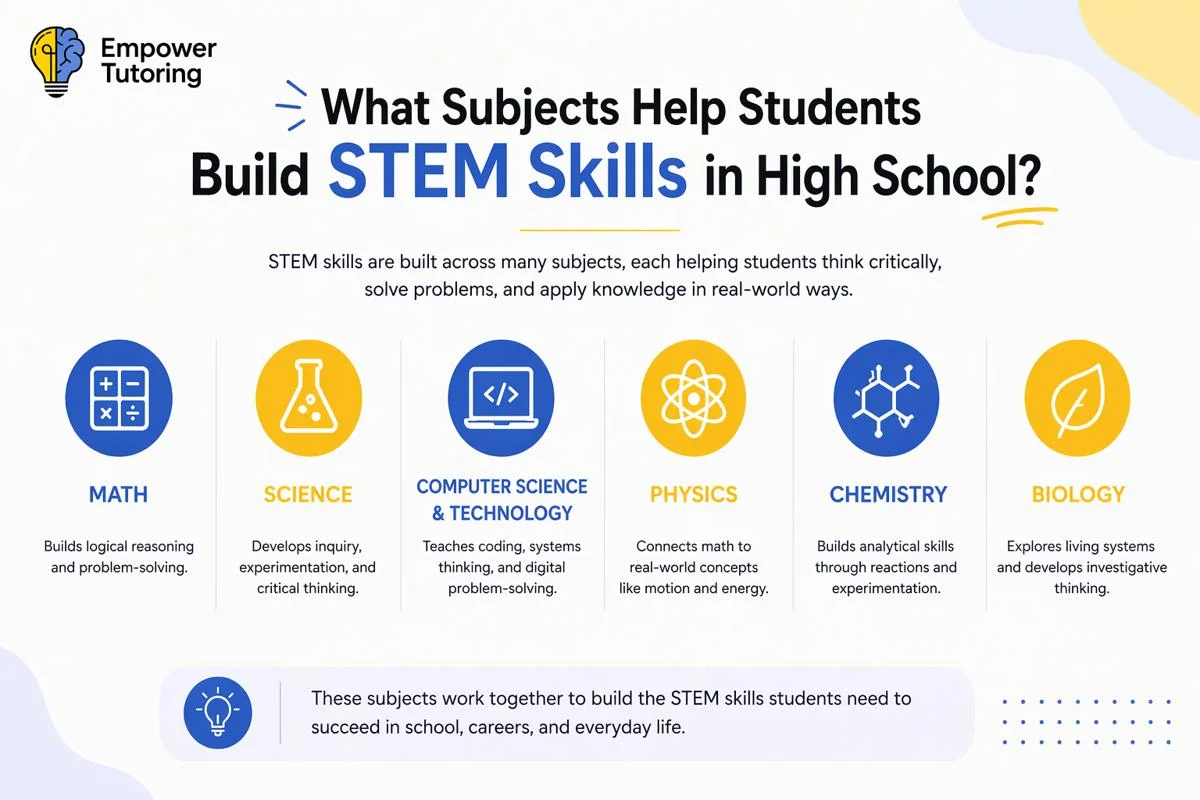
What Subjects Help Students Build STEM Skills in High School?
STEM skills are not developed in just one class; they are built across multiple subjects throughout a student’s academic journey. Each subject contributes in a different way, helping students strengthen both technical knowledge and transferable thinking skills.
Math
Math builds the foundation for logical reasoning, pattern recognition, and problem-solving. Our math tutors help support students with concepts like algebra, functions, and calculus to deepen their understanding and analytical thinking that supports all areas of STEM.
Science
Science is where students begin to see STEM skills and connections come to life. In Grade 9 science, students are introduced to STEM skills to support their understanding of core areas like biology, chemistry, physics, and earth science while developing skills in experimentation, observation, and critical thinking.
Our science tutors work with students to explain how scientific concepts connect to technology, engineering, and real-world applications.
Computer Science & Technology
Computer Science & Technology introduces students to coding, systems thinking, and digital problem-solving. Our computer science tutors help students build both their technical knowledge and logical reasoning skills.
Physics
Physics strengthens the connection between math and real-world applications. Our physics tutors help students to understand essential concepts like how to model motion, forces, and energy to reinforce problem-solving and analytical thinking.
Chemistry & Biology
Both chemistry and biology help develop investigative and analytical skills. Our biology tutors and chemistry tutors both help students learn to test hypotheses, analyze results, and understand complex systems, which are key components of STEM thinking.
How Empower Tutoring Supports STEM Skills Across Subjects
Developing strong STEM skills often requires more personalized support, especially as concepts become more complex.
Empower Tutoring’s tutoring services offer one-on-one support with students to strengthen STEM skills across subjects like math, science, and computer science. Each session is tailored to the student’s learning style, helping them build confidence while improving their understanding of key concepts.
For students in Grade 9 science, this support is especially valuable. This is where many students are first introduced to STEM skills and connections in a structured way. With the guidance of a tutor, students can:
- Better understand how concepts connect across science, math, and technology
- Build confidence with experiments, data analysis, and scientific reasoning
- Strengthen foundational skills that prepare them for future courses like physics, chemistry, and functions
As students progress into more advanced subjects, continued support in areas like physics, chemistry, and math helps them apply STEM skills at a higher level and stay on track academically.
How to Develop STEM Skills
Developing STEM skills doesn’t require a specific career path. It starts with building strong habits and approaches to learning. Here are some effective ways students can develop these skills:
- Practice problem-solving regularly
- Ask deeper questions
- Engage in hands-on learning
- Use technology as a tool
- Seek support when needed
- Stay consistent
Frequently Asked Questions (FAQ)
Why are STEM skills important for students?
STEM skills are important because they help students improve academic performance, build problem-solving abilities, and prepare for future careers in a wide range of industries.
How can students improve their STEM skills?
Students can improve their STEM skills by practicing regularly, asking questions, working on real-world problems, using technology, and getting extra support when needed.
Are STEM skills only useful for science and math careers?
Not at all! STEM skills are used in many fields, including business, healthcare, marketing, and finance, because they support decision-making and problem-solving.
How do schools teach STEM skills?
Schools teach STEM skills through integrated learning, hands-on projects, experiments, and real-world problem-solving activities that connect multiple subjects.
At what grade do students start learning STEM skills and connections?
Students begin developing STEM skills early, but Grade 9 science is often where STEM skills and connections are introduced more formally, helping students see how different subjects work together.
How can tutoring help with STEM skills?
Tutoring provides personalized support that helps students better understand complex concepts, strengthen problem-solving skills, and build confidence across STEM-related subjects. Connect with Empower Tutoring today to get started!